Understanding Nuclear Organization
The cell nucleus is a highly organized compartment containing distinct structures visible through advanced microscopy techniques. This database provides comprehensive access to both microscopic visualization and detailed molecular analysis of nuclear components.
Our enhanced database now includes 25 comprehensive reviews covering the molecular mechanisms, biophysical properties, and functional significance of nuclear structures, complementing the original microscopy-focused approach.
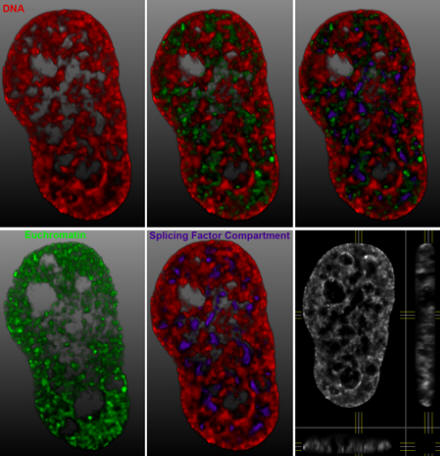
3D surface projection of HeLa cells showing histone H3K4me3 (green), DNA (red), and splicing factors (purple)
Transmission Electron Microscopy
Direct Visualization of Nuclear Components
Transmission electron microscopy allows direct visualization of individual nuclear components with molecular resolution. Unlike fluorescence microscopy, TEM visualizes structures themselves without fluorescent probes, providing unparalleled detail of nuclear ultrastructure.
Technical Specifications
- • Section thickness: 70-90 nm
- • Molecular resolution capability
- • 3D reconstruction possible
- • Direct structural visualization
Applications
- • Nuclear body ultrastructure
- • Chromatin organization
- • Nuclear envelope analysis
- • Molecular complex imaging
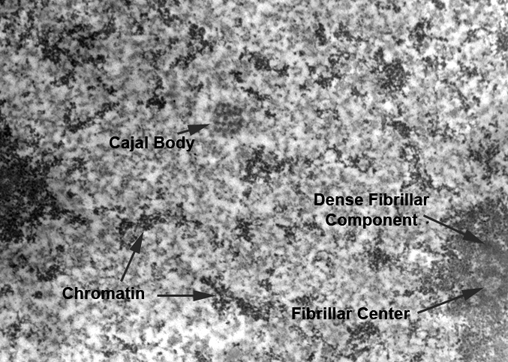
Transmission electron micrograph of a Cajal body showing detailed ultrastructure
Detailed Cajal Body ReviewFluorescence Microscopy
Dynamic Nuclear Organization
Fluorescence microscopy enables real-time visualization of nuclear proteins and structures in living cells. Using fluorescently tagged antibodies and proteins, we can study the distribution and dynamics of nuclear components with unprecedented detail.
Live Cell Imaging
Study dynamic properties through time-lapse microscopy of living cells, revealing molecular kinetics and structural reorganization.
Live Cell Transcription ReviewMolecular Kinetics
FRAP and FCS techniques measure protein diffusion and reveal structure-function relationships in nuclear compartments.
Biophysical Properties Review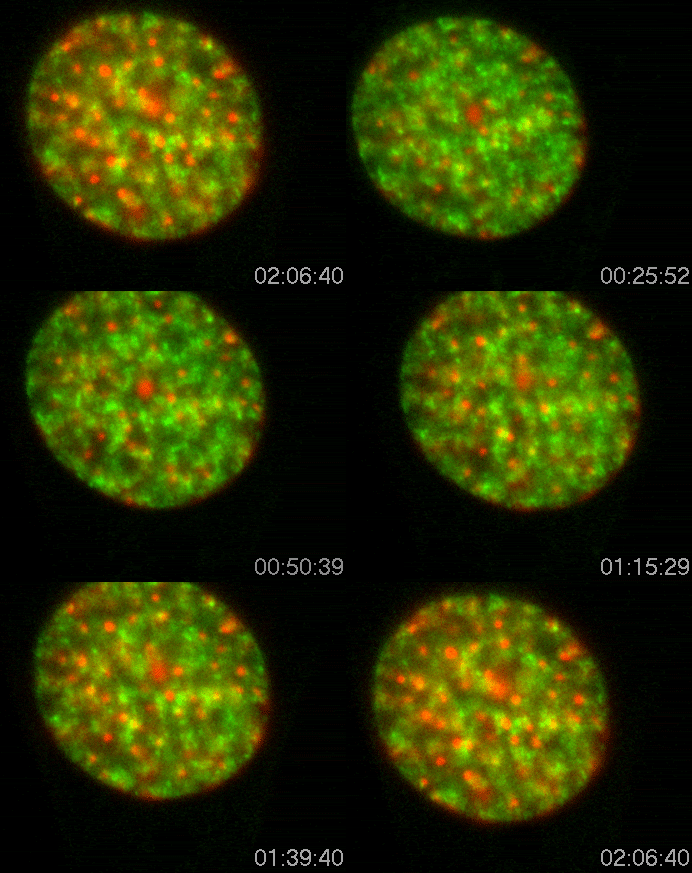
Time-lapse imaging showing dynamic nuclear reorganization
Nuclear Architecture
Nuclear Envelope
Double membrane system controlling nucleocytoplasmic transport and maintaining nuclear identity.
Nuclear Lamina
Fibrous protein network providing structural support and organizing chromatin at the nuclear periphery.
Biophysical Properties
Physical principles governing nuclear organization, mechanics, and molecular dynamics.
Nuclear Bodies and Compartments
Chromatin Organization and DNA Processes
Chromatin Architecture
3D organization and dynamic structure of chromatin in the nucleus.
Architecture ReviewEuchromatin
Open, transcriptionally active chromatin regions with dynamic accessibility.
Euchromatin StudyHeterochromatin
Condensed, transcriptionally silent chromatin maintaining genome stability.
Histone Modifications
Post-translational modifications regulating chromatin structure and function.
PTMs AnalysisDNA Repair Foci
Specialized nuclear compartments for DNA double-strand break repair.
Repair MechanismsReplication Sites
Dynamic nuclear factories orchestrating genome duplication during S-phase.
Replication DynamicsRNA Processing and Transport
Intranuclear mRNA Transport
Mechanisms of mRNA trafficking from transcription sites to nuclear pores.
Transport MechanismsNuclear RNP Structure
Ribonucleoprotein complexes and their roles in nuclear RNA metabolism.
RNP Analysis