This page is linked to its matched long-form source review. Read online and submit correction suggestions, or download the full document.
Source file: Nuclear Biophysics Comprehensive Review_.docx | Match confidence: high
The cell nucleus operates as a sophisticated mechanosensory organelle, integrating mechanical signals from the extracellular matrix through the cytoskeleton to regulate genome function. This comprehensive review synthesizes cutting-edge research on nuclear biophysics, mechanotransduction pathways, and their implications for health and disease.
The nucleus functions as a dynamic mechanosensor, converting physical forces into biochemical signals that regulate gene expression and cellular behavior.
Mechanical forces travel from the extracellular matrix through the cytoskeleton via the LINC complex to directly influence chromatin organization and nuclear function.
Advanced biophysical techniques enable precise measurement of nuclear mechanical properties, from piconewton forces to elastic moduli.
| Cell Type | Young's Modulus (kPa) | Method |
|---|---|---|
| hESC (undifferentiated) | 1-2 | Micropipette |
| hESC (differentiated) | 6-12 | Micropipette |
| MEF (wild type) | ~10 | AFM |
| MEF (Lmna -/-) | ~2.5 | AFM |
| MCF-10A (normal) | 0.2-0.9 | AFM |
| MCF-7 (cancer) | 0.1-0.4 | AFM |
| Parameter | Value | Cell Type |
|---|---|---|
| Apparent Viscosity | 100-200 Pa·s | Neutrophil |
| Instantaneous Modulus | 1.8 kPa | Chondrocyte |
| Equilibrium Modulus | 0.5 kPa | Chondrocyte |
| Fast Relaxation | ~0.1 s | MCF-7 |
| Slow Relaxation | ~1.0 s | MCF-7 |
| Creep Exponent (α) | 0.2-0.6 | Various |
Force generation and transmission
Force sensing and conversion
Force propagation network
Nuclear envelope coupling
Gene regulation response
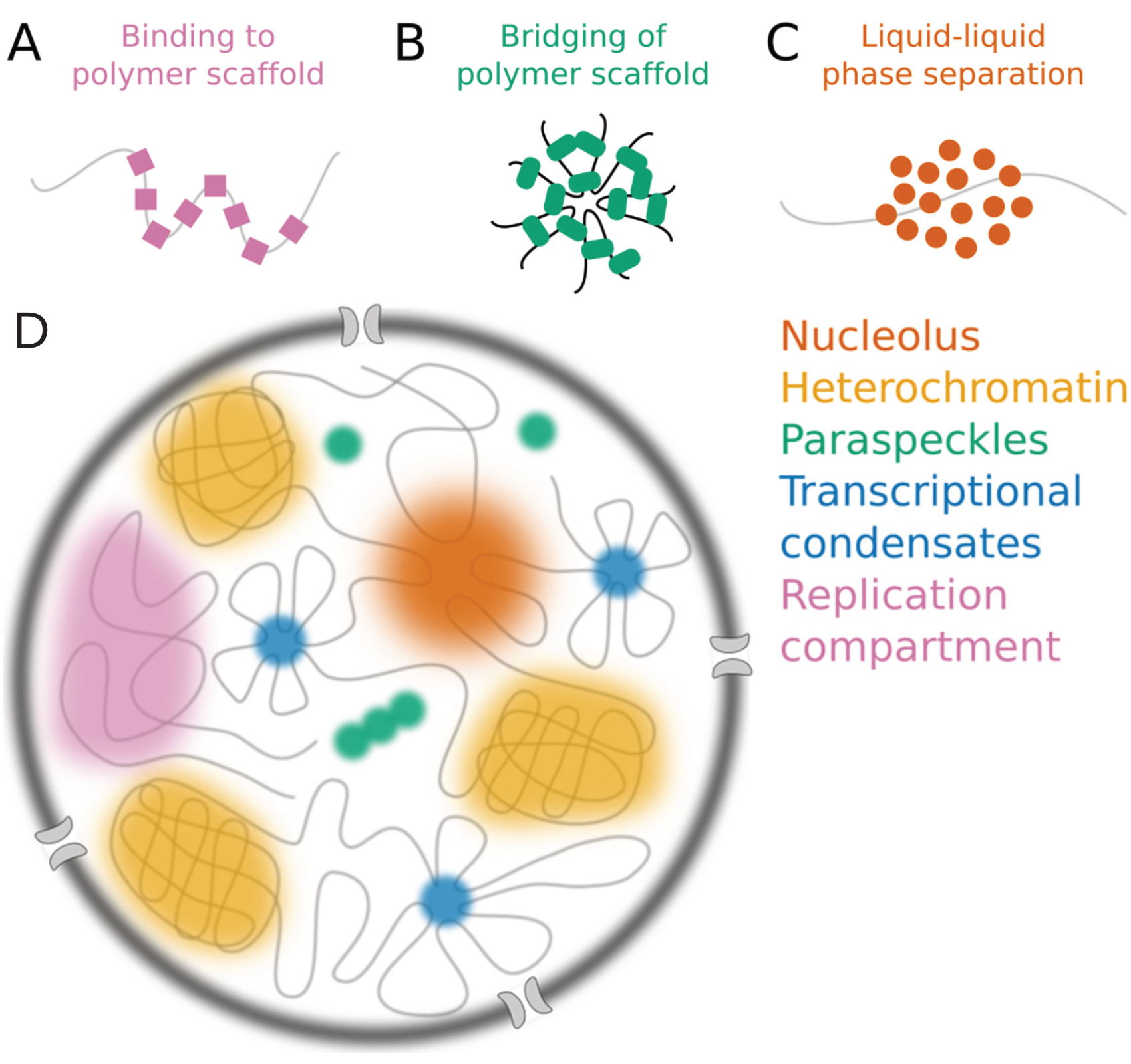
Nuclear bodies exist on a spectrum from highly fluid (nucleolus) to solid-like (PML bodies), with material properties directly linked to their specific functions.
Nuclear fragility, decreased stiffness, mechanical weakness
Increased nuclear rigidity, abnormal nuclear shape
Altered mechanosensitivity, force transmission defects
Metastatic cancer cells exhibit significantly reduced nuclear stiffness, facilitating migration through confined spaces.
The nucleus operates as a sophisticated mechanostat, actively sensing, integrating, and responding to mechanical forces. Understanding these biophysical principles provides new therapeutic targets for diseases ranging from cancer to premature aging, while opening frontiers in nuclear engineering and regenerative medicine.