Phase Separation and Biomolecular Condensates: A Comprehensive Analysis of Nucleolus, Nuclear Speckles, Cajal Bodies, and PML Bodies
This page is linked to its matched long-form source review. Read online and submit correction suggestions, or download the full document.
Source file: Nuclear Body Biophysics Review_.docx | Match confidence: high
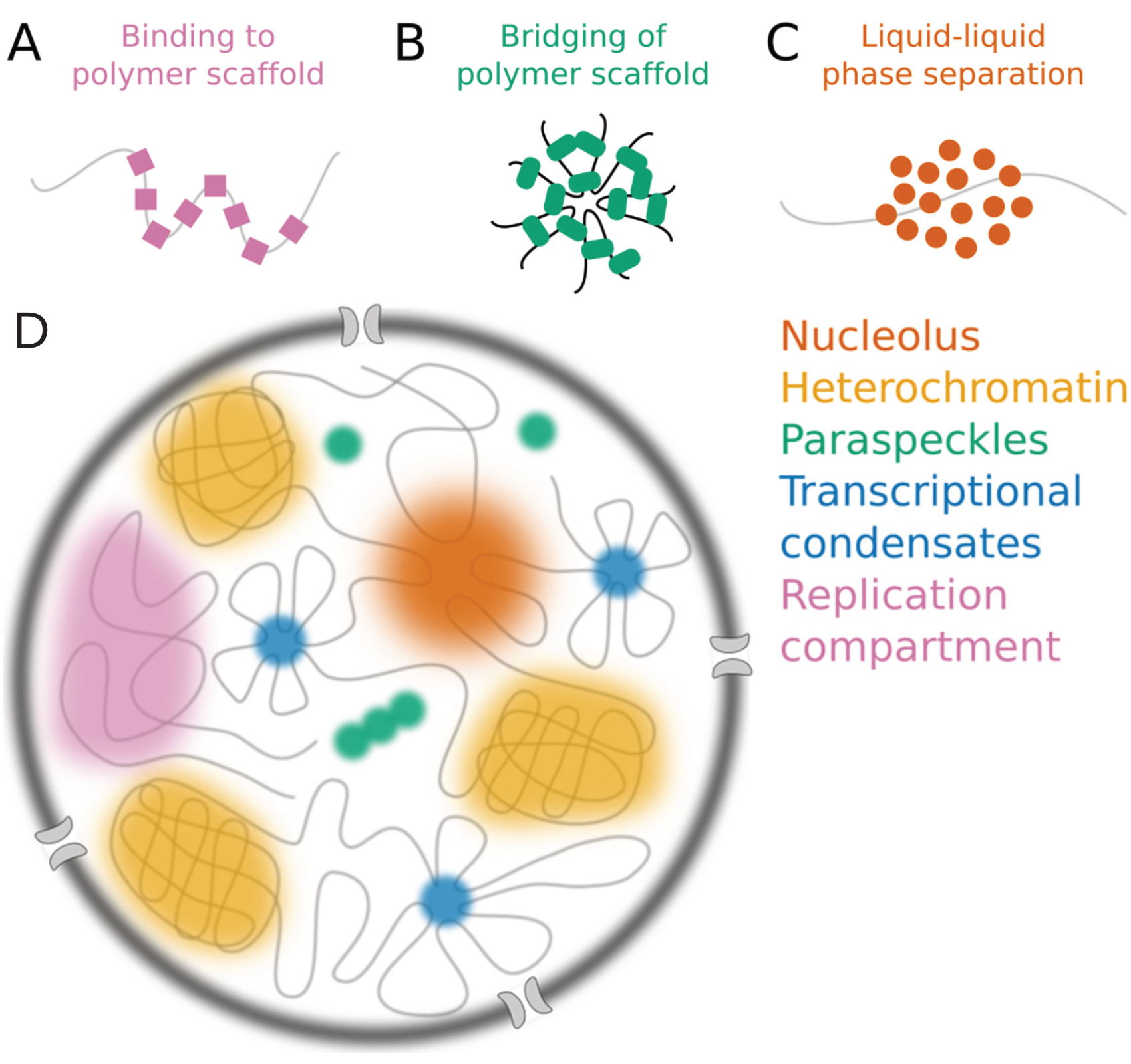
The eukaryotic nucleus employs a revolutionary organizational principle beyond traditional membrane-bound organelles. Nuclear bodies represent membraneless organelles formed through liquid-liquid phase separation (LLPS), creating specialized biochemical compartments with unique biophysical properties.
Nuclear membraneless compartments and their formation mechanisms
LLPS occurs when a solution of macromolecules spontaneously demixes into two coexisting liquid phases:
Condensate enriched in interacting components (proteins, RNAs)
Surrounding nucleoplasm with lower concentration
Key Finding: Nucleolus exhibits extremely low surface tension (~10⁻⁶ N/m), facilitating rapid fusion and dynamic behavior.
Key Finding: Nucleoplasm viscosity (~10³ Pa·s) is thousands of times more viscous than honey, affecting molecular transport.
Highly Fluid
Viscoelastic
Solid-like
Nucleolus
Speckles
Cajal
PML
Functional Relationship
Material state directly correlates with functional requirements: fluid bodies enable rapid mixing and exchange, while solid-like bodies provide stable platforms for sequential processes.
| Feature | Nucleolus | Nuclear Speckles | Cajal Bodies | PML Bodies |
|---|---|---|---|---|
| Primary Function | Ribosome biogenesis & stress sensing | Pre-mRNA processing & splicing | snRNP & snoRNP maturation | Protein modification & sequestration |
| Key Scaffolds | rRNA, fibrillarin, nucleolin | Pre-mRNA, SR proteins | Coilin, snRNAs | PML, SUMO, Sp100 |
| Assembly Driver | rRNA transcription | RNA Pol II activity | snRNA synthesis | SUMOylation cascade |
| Material State | Fluid liquid (multi-phase) | Dynamic liquid | Gel-like | Stable, solid-like shell |
| Component Dynamics | Rapid exchange, high mobility | Seconds to minutes | Multi-state (fast & slow) | Slow, stable assembly |
| Key Regulatory PTM | Phosphorylation | Phosphorylation | Methylation | SUMOylation |
| Role of RNA | Central scaffold & client | Substrate & organizer | Substrate for modification | Minimal/none |
Aberrant ribosome biogenesis, enlarged nucleoli, disrupted phase separation balance
PML-RARα fusion proteins disrupt normal SUMOylation and tumor suppressor functions
ATRA therapy restores PML body assembly in acute promyelocytic leukemia
IDR-containing proteins undergo pathological liquid-to-solid phase transitions
Cajal bodies and nuclear speckles show altered dynamics in neurodegenerative diseases
Targeting phase separation modulators to restore normal condensate properties
The field of nuclear body biophysics stands at the forefront of a paradigm shift in cell biology. Understanding how phase separation creates functional compartments without membranes opens new therapeutic avenues for diseases ranging from cancer to neurodegeneration.
Synthetic biology approaches to design custom nuclear bodies with specific functions
Drugs that modulate phase separation properties for disease treatment
Personalized therapies based on individual nuclear body biophysics